- Exclusivité web !
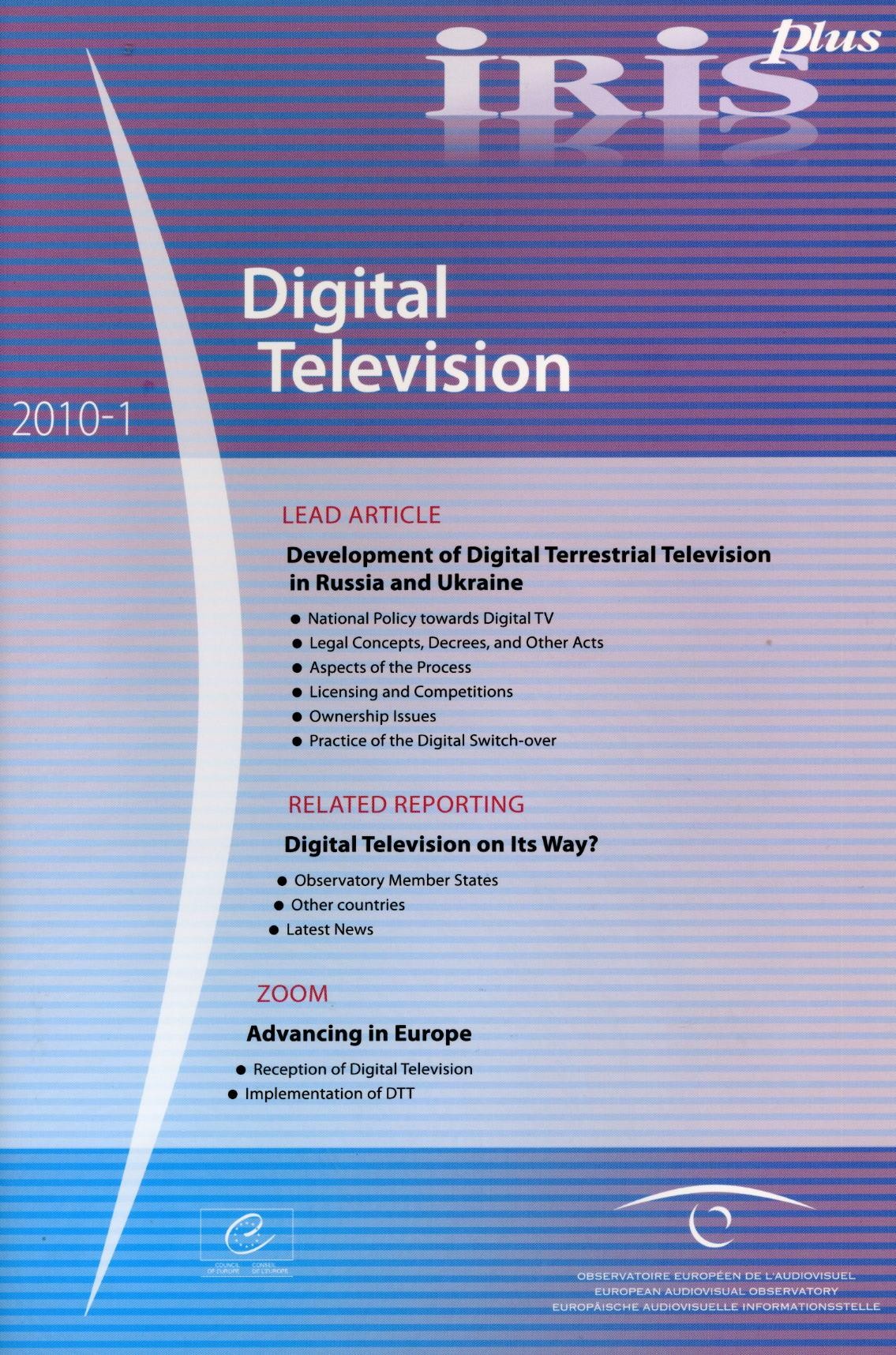
LEAD ARTICLE
Development of Digital Terrestrial Television in Russia and Ukraine
In Russia and Ukraine the goal to switch-off analogue digital television still seems to be pie in the sky. The lead article of this IRIS plus focuses on these two countries and their national policies for catching up with their digitally more advanced European neighbours.
- National Policy towards Digital TV
- Legal Concepts, Decrees, and Other Acts
- Aspects of the Process
- Licensing and Competitions
- Ownership Issues
- Practice of the Digital Switch-over
RELATED REPORTING
Digital Television on Its Way?
In Europe, the transition to digital television is challenging not only Russia and Ukraine. The list of those which only very recently introduced digital services or are about to launch them this year reaches alphabetically from Bulgaria to Turkey. This chapter updates on 2009 developments in many of these countries.
- Observatory Member States
- Other countries
- Latest News
ZOOM
Advancing in Europe
The ZOOM presents the number of digital TV households for all reception modes in Europe. It lists the launch dates for digital terrestrial television services, the dates of the analogue switch-off, the different DTT business models, the number of multiplexes as well as their operators and/or DTT packagers, and the adopted video/audio standard.
- Reception of Digital Television
- Implementation of DTT