

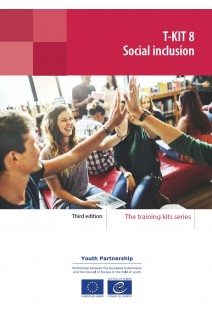
How can we help young people overcome the obstacles they may face in their quest for self-realisation and full participation in society?
Today, there is an ample and nuanced understanding of what social exclusion is, the groups of young people affected by it, its long-term impact on young people’s lives and how comprehensive policies can address it. In contrast to when the first edition of this T-Kit was published, in 2003, there is now a common understanding that youth policies and research should provide a strong base for youth work to reach out and support young people with fewer opportunities.
This revised T-Kit aims to equip youth work practitioners with broad knowledge of the concepts of social exclusion and inclusion, as well as things to consider when engaging in youth work with young people with fewer opportunities. The practical part of the T-Kit includes a range of projects, approaches and activities to inspire youth workers, covering the five “A”s: 1. Awareness of the realities of social exclusion, 2. Access to empowering and inclusive activities, 3. Action and support mechanisms for inclusion, 4. Accreditation and recognition of experience, progress and achievement and 5. Advancement, laying down supportive stepping stones towards inclusion.
PREFACE
PART I – SOCIAL INCLUSION IN EUROPE
CHAPTER 1 – INTRODUCTION
CHAPTER 2 – DEF INITIONS
CHAPTER 3 – FORMS OF EXCLUSION
CHAPTER 4 – HOW TO REACH ALL
CHAPTER 5 – YOUNG PEOPLE AND THEIR CONTEXT
CHAPTER 6 – DIFFERENT WORKING CONTEXTS
CHAPTER 7 – YOUTH WORK AND SOCIAL INCLUSION
CHAPTER 8 – PRACTICE
PART II – EDUCATIONAL ACTIVITIES AND PROJECTS
INTRODUCTION
1. Awareness: the realities of social exclusion
2. Access: empowering and inclusive activities and actions
3. Action: support mechanisms for inclusion
4. Accreditation: recognition of experience, progress and achievements
5. Advancement: supportive stepping stones towards inclusion
BIBLIOGRAPHY
How can we help young people overcome the obstacles they may face in their quest for self-realisation and full participation in society?
Today, there is an ample and nuanced understanding of what social exclusion is, the groups of young people affected by it, its long-term impact on young people’s lives and how comprehensive policies can address it. In contrast to when the first edition of this T-Kit was published, in 2003, there is now a common understanding that youth policies and research should provide a strong base for youth work to reach out and support young people with fewer opportunities.
This revised T-Kit aims to equip youth work practitioners with broad knowledge of the concepts of social exclusion and inclusion, as well as things to consider when engaging in youth work with young people with fewer opportunities. The practical part of the T-Kit includes a range of projects, approaches and activities to inspire youth workers, covering the five “A”s: 1. Awareness of the realities of social exclusion, 2. Access to empowering and inclusive activities, 3. Action and support mechanisms for inclusion, 4. Accreditation and recognition of experience, progress and achievement and 5. Advancement, laying down supportive stepping stones towards inclusion.