

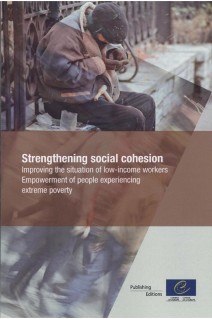
Poverty has become a challenge for European societies. Employment is often considered to be a key route out of poverty, whereas unemployment is seen as a major cause of poverty and social exclusion. Employment does not prevent poverty among the working population, however, and low-income employment has become an important policy issue in Europe.Empowerment of those experiencing extreme poverty in their daily life is one strategy to combat this phenomenon. Empowerment provides individuals living in poverty with the tools which enhance their ability to deal with the situation.This publication is designed to assist policy makers and service providers at national and local levels to develop effective strategies to improve the situation of low-income workers and to empower people experiencing extreme poverty in Europe.It is an important contribution to the implementation of the Council of Europe's Revised Social Cohesion Strategy, as well as to the European Year for Combating Poverty and Social Exclusion, launched by the European Union in 2010.
Foreword
Improving the situation of low-income workers
Executive summary
1. Introduction
1.1 Terms of reference
1.2 Working methods
2. Definitions
2.1 Defining low-income workers
2.2 Defining low pay
2.3 Working definition
3. Quantifying low-income work
4. Profile of low-income workers
4.1 Low income versus unemployment
5. Factors determining low-income work
5.1 Societal factors
5.1.1 Gender
5.1.2 Location
5.2 Individual factors
5.3 Employment factors
6. Barriers to employment
7. Consequences of low income work
8. European and public policies: making work pay
8.1 Tax and welfare policies
8.2 Employment policy
8.3 Education and training policy
8.4 Corporate social responsibility
Bibliography
Empowerment of people experiencing extreme poverty
Introduction
1. Extreme poverty and social exclusion
1.1 Definitions
1.2 Three premises on extreme poverty and social exclusion
2. What is empowerment?
2.1 Definition
2.2 Different dimensions of empowerment
3. Towards policies for empowerment of people experiencing extreme poverty
3.1 Extreme poverty is plural
3.2 Rights-based intervention
3.3 Co-ordinated approach
3.4 Evaluation and quality protection
4. Building individual capacity
4.1 Basic material support
4.1.1 Illustrations of basic material support
4.1.2 Criteria for empowering basic support
4.2 Allowances and credits
4.2.1 Some examples of benefits
4.2.2 Criteria for empowering financial support
4.3 Access to social services
4.3.1 Integrated social services
4.3.2 The case of over-indebtedness
4.3.3 Empowering social services
4.4 Economic activation policies
4.4.1 Kinds of activation policies
4.4.2 Empowerment by economic activation policies
5. The power of social networks
5.1 In-group solidarity
5.2 Out-group solidarity
5.3 Community development
6. Raising (political) voices
6.1 Bottom-up participation
6.2 Top-down participation
6.3 Participation structures and methods
6.3.1 Structures
6.3.2 Methods
Conclusion
Overview of definitions of empowerment
Bibliography
Appendices
Appendix I
Guidelines
Appendix II
Members of the Committee of Experts on Improving the Situation of Low-Income Workers
Appendix III
Members of the Committee of Experts on Empowerment of People Experiencing Extreme Poverty

Poverty has become a challenge for European societies. Employment is often considered to be a key route out of poverty, whereas unemployment is seen as a major cause of poverty and social exclusion. Employment does not prevent poverty among the working population, however, and low-income employment has become an important policy issue in Europe.Empowerment of those experiencing extreme poverty in their daily life is one strategy to combat this phenomenon. Empowerment provides individuals living in poverty with the tools which enhance their ability to deal with the situation.This publication is designed to assist policy makers and service providers at national and local levels to develop effective strategies to improve the situation of low-income workers and to empower people experiencing extreme poverty in Europe.It is an important contribution to the implementation of the Council of Europe's Revised Social Cohesion Strategy, as well as to the European Year for Combating Poverty and Social Exclusion, launched by the European Union in 2010.