

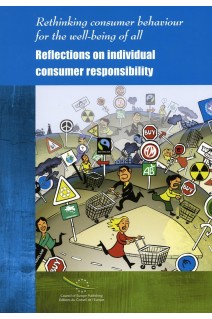
This guide invites the reader to think about consumption as one factor in the difficult task of building cohesive, sustainable societies based on the principle of universal well-being. The Council of Europe hopes that this reassessment will prompt people to question their choices as consumers: taking account of human rights, decent working conditions, the sustainable use of resources and our legacy to future generations. Surely consumption should be a responsible, socially committed act.An eclectic mix of academic articles, examples and illustrations makes this guide an unusual, informative work which can be readily used as the basis for discussions on this pressing social issue.This book, inspired by a contribution from the European Inter-Network of Ethical and Solidarity-Based Initiatives (IRIS), is intended as a "prototype": readers are free to adapt its contents to their own circumstances, to add relevant examples and to bring the ideas presented to life.
Foreword
Introduction
Part I -- Consumption as an expression or citizenship
The nature and culture or consumption in consumption societies
Democratisation and consumption
Consumers and citizenship
No need to edit? Is faith in consumer sovereignty justified?
From consumer sovereignty to consumer governance. Room for choice in consumption
Consumers' concerns and alternative choices
Part II -- Contributing to general well-being through a more balanced approach
When overabundance is detrimental
Value, depreciation and the maintenance or wealth
Consuming with respect for the environment and nature generations: towards more sustainable consumption
Part III -- Contributing to general well-being through a better choice or goods
Transforming consumption by rejecting the unacceptable
Consumers as citizens: synergies and tensions for well-being and civic engagement
Fighting for human rights: consumption behaviour as political praxis
Combating excessive fragmentation by collective organisation or choices
Part IV -- Contributing to general well-being through prior links with producers
From socially responsible consumers to co-producers
Fair trade: long-distance and short supply chains. When buying goods means showing solidarity with producers
Supporting local farmers through customer loyalty
Using money differently
Part V -- Making consumers more aware or their responsibilities
Education for responsible consumption
Consumer information: labels, eco-labels and product comparison to tackle the current information asymmetry: advantages and limits
Responsible consumption: bow to make information accessible to all and make proximity an instrument for consolidating action
Conclusion
From poverty to the sobriety model
Appendix

This guide invites the reader to think about consumption as one factor in the difficult task of building cohesive, sustainable societies based on the principle of universal well-being. The Council of Europe hopes that this reassessment will prompt people to question their choices as consumers: taking account of human rights, decent working conditions, the sustainable use of resources and our legacy to future generations. Surely consumption should be a responsible, socially committed act.An eclectic mix of academic articles, examples and illustrations makes this guide an unusual, informative work which can be readily used as the basis for discussions on this pressing social issue.This book, inspired by a contribution from the European Inter-Network of Ethical and Solidarity-Based Initiatives (IRIS), is intended as a "prototype": readers are free to adapt its contents to their own circumstances, to add relevant examples and to bring the ideas presented to life.